
Delhi‘s retail scene has never been more competitive. Walk through any high street in South Extension, a mall in Saket, or a franchise cluster in Rajouri Garden, and you’ll notice the same thing: the stores that stop people mid-walk aren’t necessarily the ones with the biggest budgets. They’re the ones with the smartest design.
If you’re a business owner planning a new outlet, a redesign, or a multi-city rollout, choosing the right retail store design company is one of the highest-leverage decisions you’ll make this year. Get it right and your store becomes a silent salesperson — guiding footfall, holding attention, and quietly pushing conversions. Get it wrong, and you’ve spent lakhs on a space that looks fine in photos but does nothing for your business.
This guide breaks down everything you need to know before hiring a retail store design company in Delhi from understanding the design process and project costs to identifying red flags and asking the right questions.
Why Store Design Matters More in Delhi’s Retail Market
Real estate in Delhi and the NCR doesn’t come cheap. When you’re paying premium rent per square foot, every corner of your store needs to earn its keep. A poorly planned layout doesn’t just look dated — it actively wastes the space you’re paying for.
There’s also the competition factor. Whether you’re in fashion, F&B, electronics, or lifestyle retail, chances are there are three other brands doing something similar within a five-minute walk of your store. In a market this dense, design is no longer a finishing touch — it’s a differentiator.
And consumer behaviour has shifted. Shoppers today aren’t just buying products; they’re evaluating experiences. A customer decides whether your store feels worth exploring within the first few seconds of walking in. That decision is shaped almost entirely by layout, lighting, and how the space is organised — long before your product quality even enters the conversation.
At WBC Labs, this is the exact gap we work in—helping retail brands in Delhi turn store design into a business tool, not just a visual upgrade. Explore our Retail Store Design Services to see how we approach strategy, design, and execution.
What Does a Retail Store Design Company Actually Do?
Most business owners assume “store design” just means picking furniture and paint. It’s a lot more structured than that.
Layout and Space Planning
This is the backbone of the whole project deciding traffic flow, zoning high-margin products at eye level, positioning the billing counter, and making sure customers can move through the store without friction or confusion. Good layout planning is the difference between a store people browse and one they walk straight past.
Visual Merchandising and Branding
Once the layout is set, the next layer is how your brand actually shows up — signage, fixtures, product displays, and the overall story your store tells. This is where a store stops looking generic and starts looking like your brand. It’s closely tied to, but distinct from, visual merchandising, which is more about ongoing display strategy after the store is built.
Execution and Turnkey Fit-Out
Here’s where a lot of business owners get caught off guard. Some companies only hand over design files — you’re left finding a separate contractor to actually build it. If you’re looking for a single partner to manage both design and execution, a turnkey approach can simplify the entire project lifecycle.
How Much Does Retail Store Design Cost in Delhi?
There’s no honest way to quote a flat number here, and any company that gives you one without seeing your store first should raise a flag. Cost depends on a handful of real variables:
- Store size — a 400 sq. ft. boutique and a 3,000 sq. ft. showroom aren’t remotely comparable projects
- Material grade — laminate versus veneer, standard lighting versus custom fixtures, all move the number significantly
- Design-only versus turnkey — turnkey costs more upfront but usually saves money on coordination and rework
- Timeline — rushed projects often carry a premium for expedited sourcing and labour
Design-Only vs. Turnkey Pricing — What’s the Difference?
Design-only pricing covers concept development, layout plans, and material specifications — you execute separately. Turnkey pricing covers design plus construction, fixtures, signage, and installation, delivered as one package. If you’re a first-time store owner or managing a rollout across multiple locations, turnkey is almost always the lower-stress, lower-risk route, even if the invoice looks bigger at first glance.
The honest way to get a real number is a site visit or brief consultation where a designer can actually scope your space — which is exactly how most credible firms, including ours, approach a first conversation.
How Long Does a Retail Store Design Project Take?
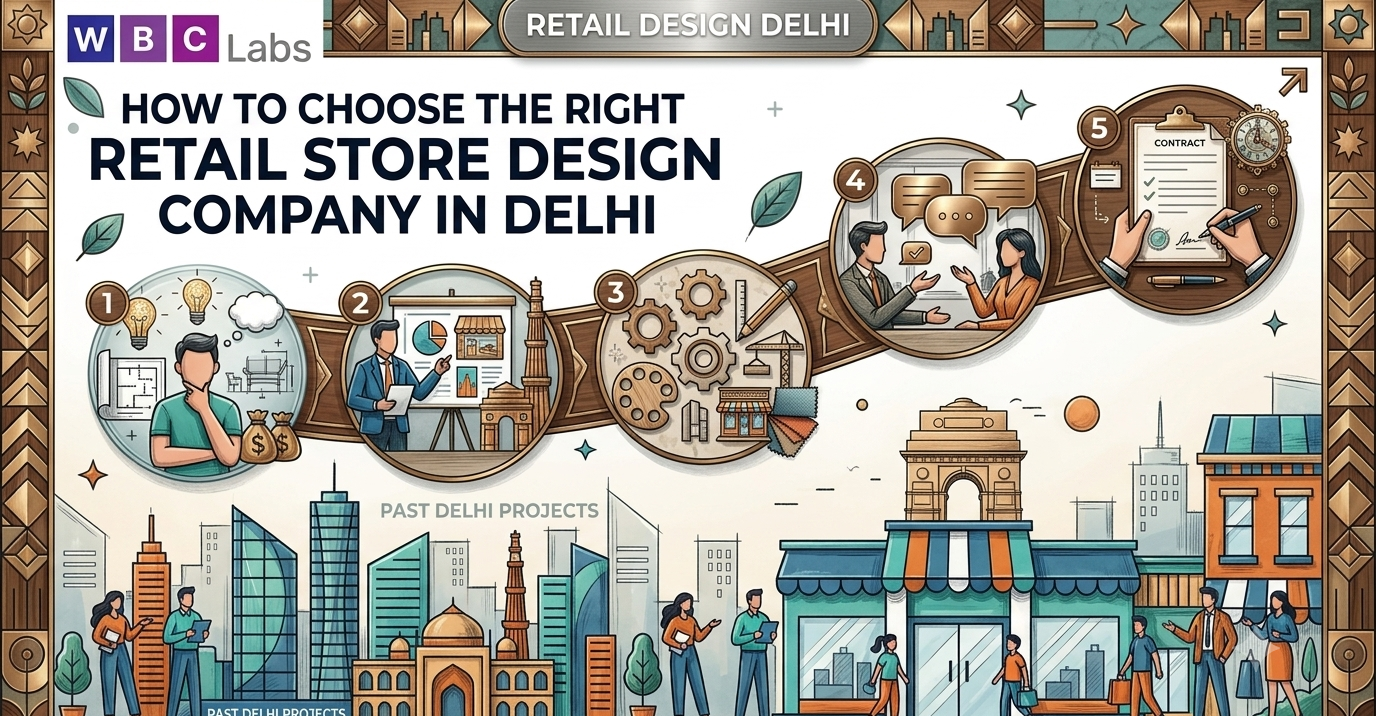
Timelines vary, but most projects move through the same broad phases: initial consultation and briefing, concept and 3D visualisation, approvals and material selection, then execution and handover.
A small-format store can move through this cycle in a matter of weeks. A large-format showroom or a multi-location rollout takes considerably longer, mainly because of approvals, material sourcing, and coordinating execution across sites. Anyone who promises an exact timeline before understanding your project scope is guessing — be wary of that.
6 Things to Check Before Hiring a Retail Store Design Company
This is the part most business owners skip, and it’s the part that saves the most money and stress later.
1. Portfolio Relevance to Your Retail Category
A firm that’s great at fashion boutiques won’t automatically nail an electronics showroom or a QSR outlet. Ask specifically for past work in your category, not just their best-looking projects overall.
2. Design and Execution Capability
Ask directly: do they design, or do they design and build? If it’s the former, you’ll need to manage a second vendor relationship, which adds risk and slows everything down.
3. Experience with Multi-Store or Franchise Rollouts
If you’re a franchise owner or planning to scale beyond one location, this matters enormously. You need a partner who can replicate brand consistency across cities without every store looking like a slightly different interpretation of your brand. Ask for examples of multi-location work specifically — not just single flagship projects.
4. Transparent Process and Timelines
A credible design partner should be able to walk you through their process phase by phase, even in a first meeting. Vague answers here usually mean disorganised execution later.
5. Material Sourcing and Vendor Network
This affects both quality and speed. A company with an established vendor network can often deliver faster and with fewer surprises than one sourcing materials ad hoc for every project.
6. Post-Launch Support
Stores need upkeep — fixtures wear out, signage fades, layouts need refreshing as your product range grows. Ask whether the company offers any support after handover, or whether you’re on your own the moment the store opens.
Common Mistakes Business Owners Make When Redesigning a Store
Common mistakes include:
- Prioritising aesthetics over customer flow.
- Ignoring brand consistency across multiple outlets.
- Underestimating approvals and execution timelines.
- Focusing only on visual preferences instead of business objectives like footfall, dwell time, and conversions.
Retail Store Design for Different Business Types in Delhi
Boutique and D2C Brands
Smaller formats need design that maximises every square foot while still telling a strong brand story — often the hardest balance to strike.
Franchise and Multi-Store Retail Chains
The priority here shifts to replicability. Design systems need to be documented well enough that store number twelve looks and feels as intentional as store number one.
Electronics and Lifestyle Showrooms
Larger formats with higher-value products need layouts that guide customers through a considered journey, rather than a flat grid of shelves.
Frequently Asked Questions
Q1) How much does retail store design cost in Delhi?
It depends on store size, finish quality, and whether you choose design-only or turnkey execution. Most credible firms will only give you a real number after seeing your space or brief.
Q2) How long does a retail store design project take?
Small-format stores typically move faster, while larger showrooms or multi-location rollouts take longer due to approvals and coordinated execution. Scope determines timeline, not the other way around.
Q3)Can a retail store design company handle franchise rollouts across multiple cities?
Yes, though not every firm has real experience with it. Look specifically for a company that can show past multi-location work and explain how they maintain brand consistency across sites.
Q4) What’s the difference between store design and visual merchandising?
Store design covers the space, layout, and build. Visual merchandising is the ongoing strategy for how products and displays are presented within that space, even after the store is open.
Q5) Do I need to shut my store during a redesign?
Not always. Many redesigns can be phased or scheduled around business hours, depending on scope. Worth discussing directly with your designer before assuming a full closure is needed.
Q6) What information should I prepare before contacting a store designer?
Your approximate store size, existing brand guidelines (if any), a rough budget range, and your target launch timeline. The more specific you are upfront, the more accurate the first conversation will be.
Final Thoughts — Choosing a Partner, Not Just a Designer
Store design isn’t decoration. It’s a business investment that shows up directly in footfall, dwell time, and repeat visits. The right partner won’t just hand you a nice-looking layout — they’ll build something that holds up across locations, ages well, and actually moves your numbers.
Planning a new store, a redesign, or a multi-location rollout in Delhi? WBC Labs works with retail brands to design spaces that convert footfall into loyal customers. Get in touch for a consultation tailored to your store and your goals.